
This article was written by Pavol Lupták from Liberation Travel, documenting his recent return to Roatán after almost eight years. Pavol reflects on how much the island has transformed – from crumbling roads replaced with fresh concrete to a booming service scene where you can even buy world-class Geisha coffee with Bitcoin Lightning. He also explores Prospera, a unique private city built on market-driven principles, and visits our Bitcoin Center, which has helped turn Roatán into a vibrant Bitcoin hub.
Residence in Honduras with territorial taxation, a non-CRS bank account, and everything handled remotely!
Sounds unbelievable? We are actively working on it.
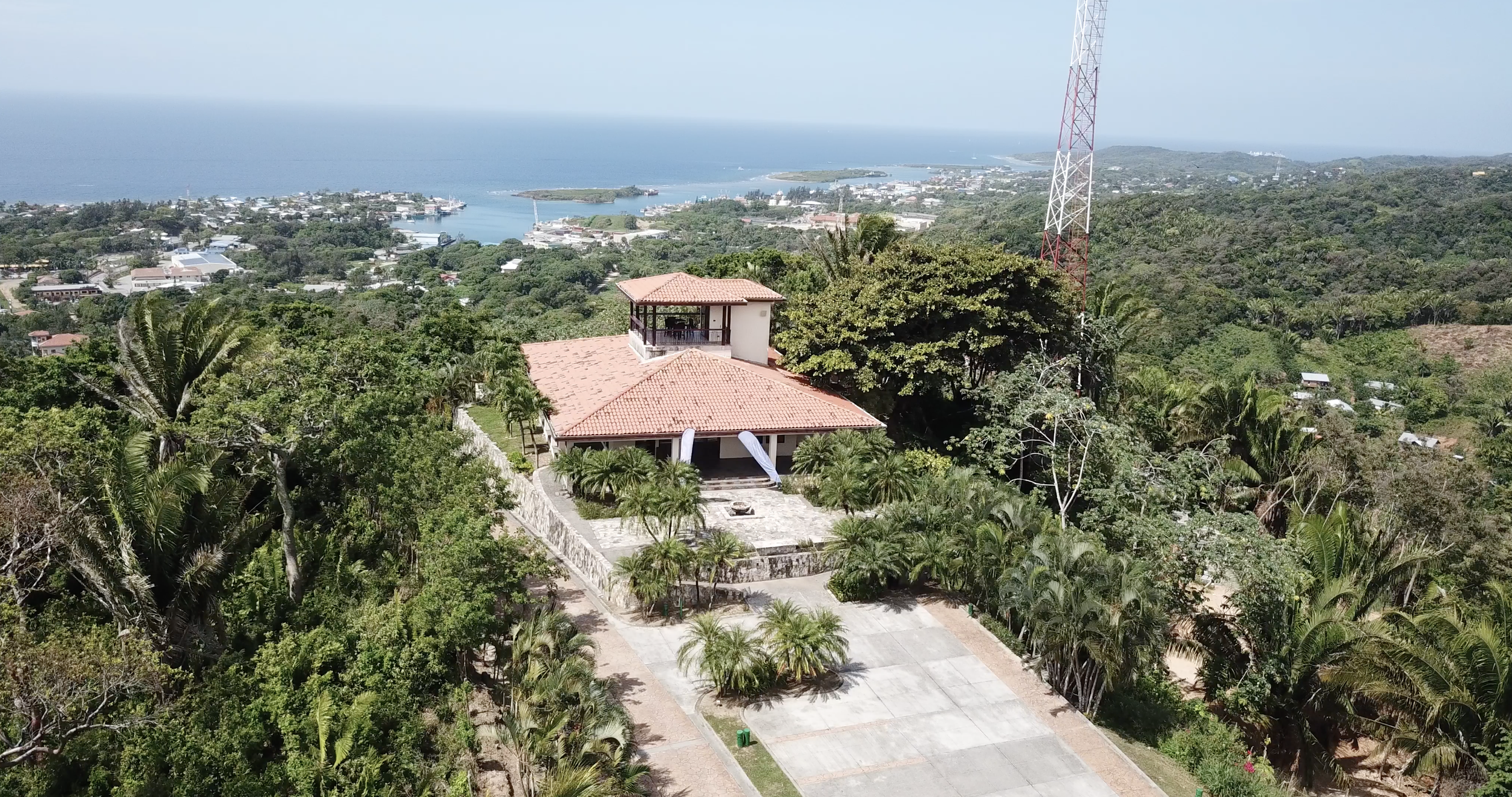
Roatán is an island in the Caribbean that I last visited almost 8 years ago. At that time, I was surprised by the strong Czech community that actively lives here, even in two Czech villages. In those few years, Roatán has changed significantly. The completely broken roads have practically disappeared, replaced by beautiful concrete ones, and services have expanded and improved considerably, not only for tourists (for example, at Spirit Animal Coffee, you can get the highest-quality Geisha or Bourbon-filtered coffee in the world for Bitcoin Lightning).
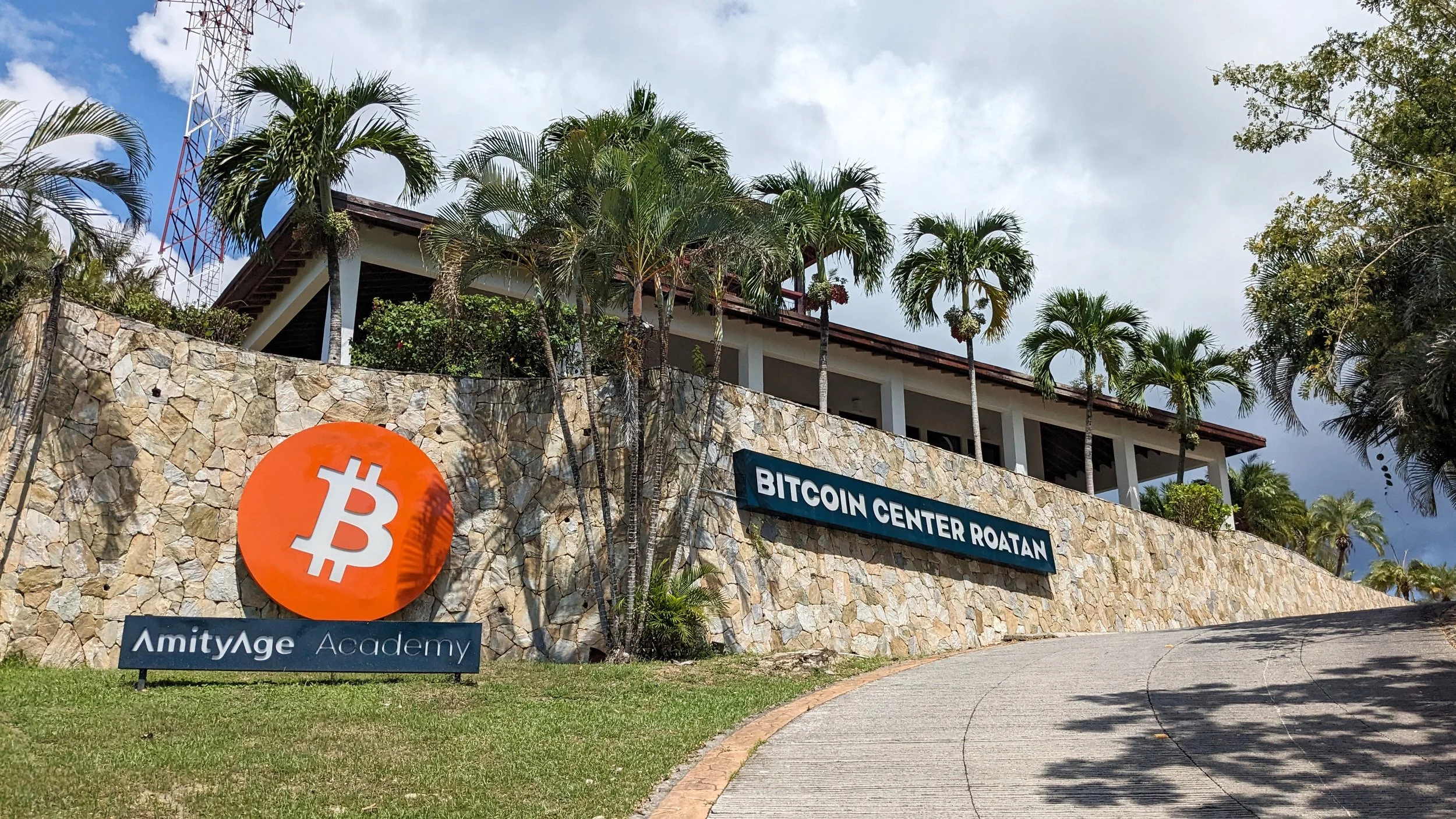
A unique project called Prospera, a private city built on market principles, has been created here, which I finally decided to visit and support. My friend and our Paraguayan guy, Dušan Matuška, has launched a unique AmityAge Bitcoin center here and has practically converted Roatán to Bitcoin.
I'm not traveling to Honduras for nothing — I opened a bank account here in the best Honduran bank, Banco Atlántida, in dollars and lempiras. I tried crypto transfers from my Binance P2P to my Honduran account and payments with my Honduran VISA Platinum. I underwent a quick medical examination, signed the necessary power of attorney with a lawyer, and applied for Honduran residency (rentista).
After Panama, Paraguay, and Uruguay, this will be my fourth residency in a country with territorial taxation.
Honduran residency
Honduras supports several types of residency:
Rentista - for people with passive income (annuities, investments, dividends).
Pensionado — for retirees with a lifetime pension from abroad.
Investor (Inversionista) — for people who invest capital in a Honduran company or project.
Work residence — for people with an employment contract with a Honduran company.
Family reunification — spouse, children, or parents of a Honduran citizen or resident.
Humanitarian reasons — asylum, refugees, exceptional cases.
I analyzed all of the above options and decided on the Rentista option, which is the simplest and least bureaucratic way to obtain residency not only for me, but also for our potential clients.
Conditions for obtaining temporary "Rentista" residency in Honduras
Stable passive income — you must prove a minimum income of $2,500 (or the equivalent in local currency) to a Honduran bank.
I want to point out that income can also come from a person on the Binance P2P Honduran crypto market (I tried it, it works great) or from another person with a bank account here. This income of at least USD 2,500 must be deposited into your Honduran account every month. However, you can withdraw it with your Honduran VISA card anywhere in the world, or use it to pay.
If you have any crypto passive income/savings, not only can you exchange it for fiat via Binance P2P and a non-CRS Honduran bank and spend it anywhere in the world, but you will also meet the "Rentista" condition for extending your Honduran residency.Prove that you own assets that generate this income (e.g., real estate, securities, crypto, or other means).
Paper photographs (6 cm × 5 cm) — I would like to point out that, unlike Paraguay, Uruguay, or the EU, Honduras does not use biometric documents and continues to use paper photographs. Similarly, it does not collect fingerprints (for residency). This means you do not have to go to the immigration department in person (!), but you can complete the entire residency application remotely (!) using a power of attorney.
Certificate of good conduct (criminal record) from your country of origin + from your current place of residence (if required). Plus a birth certificate. Everything must be apostilled and translated into Spanish, with an apostille for the translation (we usually arrange this for our clients in all countries where they are applying for residency). Maximum 6 months old.
Local criminal record extract — Certificate from the Dirección General de Investigación Criminal (this is handled by lawyers based on a power of attorney).
Medical certificate (not older than 6 months). I physically underwent this in Honduras, but they should accept the results of any medical examination in the world (which will be notarized and translated into Spanish) (we are currently testing this).
Notarized copy of passport (all pages of passport).
If you are applying for residency from abroad, you must have the original entry letter from the Honduran consulate (solicitud de ingreso autorizada).
Honduran bank account
This is not necessary for the residence application itself. Still, for renewal of residence (after one year), you must prove passive income of at least USD 2,500 (or its equivalent) in your Honduran bank account.
You can open a Honduran bank account in lempiras or USD (I recommend both currencies). Honduras has not signed the CRS, so Honduran banks do not automatically send information about account holders to any other jurisdictions.
To open a bank account, you need a "bank reference letter" (if you have Revolut, you can generate it here) and a Honduran mobile number (see below).
I tried crypto transfers from my Binance P2P to my Honduran account and payments with my Honduran VISA Platinum. Not only does everything work fine, but I can sell my USDT at a better rate (27.90 HNL/USD) than the official mid-market rate (26.29 HNL/USD).
A Honduran bank account can be opened remotely using a power of attorney (we are currently testing this).
Honduran mobile number
To open a Honduran bank account, you need a local Honduran number. If you do not yet have residency in Honduras, you can only purchase a postpaid plan with a minimum 6-month commitment from Claro or Tigo, not a prepaid plan. Honduran Tigo does not support roaming in Europe; it only supports roaming in America. Honduran Claro supports roaming in Europe — the Conexión Sin Fronteras Europa program (130 HNL / 4.29 EUR per day) with most of Europe covered (the Czech Republic is included, but Slovakia is not) and also worldwide roaming Conexión Sin Fronteras Mundo (260 HNL / 8.59 EUR per day) with coverage in only a few countries around the world (China, Hong Kong, Israel, Japan, Qatar, Turkey, South Africa, Australia, South Korea, and India). For plans over 1899 HNL (63 EUR) per month, this roaming is included. From this point of view, Personal in Paraguay is a better option for digital nomads, as it offers 80 GB of data roaming throughout America, Europe, and several Asian countries.
If you want to apply for residency in Honduras, however, you cannot avoid getting a Honduran number (you need it for the Honduran bank account).
Applying for a Honduran number requires full KYC (including a selfie with your passport) and references from three local people in Honduras (we are currently testing obtaining a Honduran number remotely).
Tax residency
To obtain tax residency in Honduras, you must live in the country for at least 3 months (90 days) per year. It is then relatively easy to issue this confirmation.
It is easier than in El Salvador, where you must live continuously for 200 days a year (without the possibility of leaving), but more complicated than in Paraguay, where you only need to register with the tax office (SET) and fill out monthly declarations.
If you have tax residency in Paraguay or elsewhere, you do not need it in Honduras.
Conditions for extending temporary residence
Temporary residence in Honduras must be renewed each year by documenting your monthly income in a Honduran account (USD 2,500 or equivalent) and completing the required forms.
The entire residence extension process can be completed remotely via a power of attorney, and it is not necessary to visit Honduras.
In any case, one of the conditions for extending temporary residence is at least one short visit (one day is sufficient) to Honduras.
I plan to solve this by attending an interesting conference there every year; next year, it will be the Free Cities conference on September 3–6, 2026, in Prospera.
After 5 years, I can apply for permanent residence in Honduras.
Permanent residence and citizenship
After five years of temporary residence, it is possible to apply for permanent residence in Honduras, where residence cards are valid for five years, not just one. Of course, you must not have any problems with the law, and you must renew your temporary residence in an exemplary manner.
The conditions for obtaining citizenship in Honduras are similar to those in other Latin American countries — you must live there continuously for at least 3 years (unless you are a Spanish citizen or a resident of another Central American country), have a clean criminal record, pass a test on your knowledge of Honduras, demonstrate understanding of the history, geography, and constitution of Honduras, and prove that you have the means to support yourself in Honduras.
Honduras, like Paraguay, does not support dual citizenship, except for Spain.
Summary
The most significant advantage of residency in Honduras is that, unlike other countries, it is possible to apply for it thoroughly remotely, without the need to travel to the country! However, if you want to extend this residency after a year (which can also be done entirely remotely), at least one visit per year is required.
Another advantage is that it is relatively easy to open a non-CRS dollar bank account there, which is not limited in any way (compared to non-CRS Paraguay, where you can only open a basic bank account in guaraní with a monthly limit of USD 1,000 unless you have local income in the country).
The condition for extending residency (a monthly income of $2,500 in a Honduran bank account) is relatively easy to meet if you convert crypto to fiat in this amount each month, which will cover it.
Unlike most countries, it is relatively easy to obtain tax residency in Honduras; you only need to live there for at least 3 months a year (in most countries, it is 6 months).
And the last advantage is the sea. Roatán and mainland Honduras have a lot to offer if you are a fan of great ocean weather.